AI dominates the patent landscape
Every sixth patent published worldwide is now an AI patent
More than 435,000 AI patent families were published in 2025 – over 17% of approximately 2.5 million patent publications worldwide.
That means AI alone generated more patents than the next four largest technology fields combined: data security (111,000), biotech (101,000), batteries (95,000), and semiconductors (86,000).
We have not seen such a concentration of patent activity in a single technology field in the past 50 years. Twenty years ago, semiconductors accounted for 7.6% of all patent publications. In 2016, pharma reached 5.2%. AI now stands at more than 17%.
And the momentum is remarkable: since 2022, AI patent publications have more than doubled. Over the past ten years, they have increased twentyfold.
More than 80% of AI patents currently come from China. This partly reflects China’s enormous volume of domestic patenting. But even excluding purely national Chinese patents, AI still accounts for 14% of global patent publications.
Of course, quantity is not quality. Most patents will never become major innovations. That is why, at EconSight, we focus on the top 10%: World Class Patents.
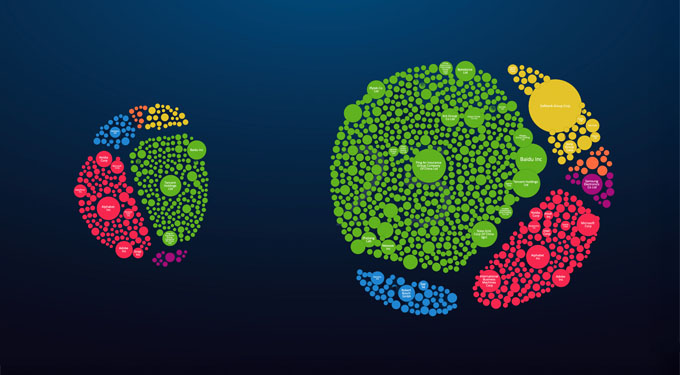
And China leads here as well. Of around 160,000 World Class AI Patents, China accounts for 81,000 – around half of the global total. The US follows with 57,000, or more than one-third, while Europe accounts for just under 9%, with 14,000.
At the company level, Tencent leads with 5,100 World Class AI Patents, followed by Baidu (4,150), Alphabet (3,950), Microsoft (3,230), and Amazon (3,180).
Among the global Top 50 AI companies, 23 are American, 14 Chinese, 8 Japanese, 2 South Korean, and just 3 European.
The patent data reveal three things: AI is becoming the dominant force in global R&D; the technological race is increasingly concentrated between China and the US – both in national patent strength and among the world’s leading AI companies – and much of its impact is still ahead of us. Patents are a forward-looking indicator, meaning that this extraordinary wave of AI innovation will only become fully visible in products and markets in the years ahead.